
How to find sponsors for your newsletter
Where newsletter sponsors actually come from, how to list the companies already paying to reach your readers, and a pitch email you can copy and send.
The rate card is written, the price is one you can defend, and the sponsor page has been live for six weeks without a single enquiry. That is normal for a newsletter with a few thousand readers. The sponsors who find a publication on their own mostly already read it, so the first sponsors are the ones you go and ask. The useful news is that the likeliest ones are easy to identify, because most of them are already paying to reach your readers somewhere else, in public.
This guide assumes you have settled what to charge for a newsletter sponsorship and have somewhere to send an interested sponsor: a rate card, or better, a sponsor page that lists your slots, prices and open dates, which Issue Mint gives every newsletter from the day it is set up. What follows is the part before that: where the leads come from, what to write, and when a marketplace is the better route.
Finding newsletter sponsors starts with who is already paying.
The sponsors most likely to book are companies already spending money to reach the people who read you. A company that has never advertised to your readers needs persuading twice: that these readers are worth reaching, and that a newsletter is a sensible way to reach them. A company already buying space in a similar newsletter, or bidding on your readers' searches, has settled both questions with its own budget. You only have to argue for your issue.
So look for evidence, not fit. "Brands that would suit us" is a list of hopes. "Companies with visible spending aimed at my readers" is a list of reasons, and a reason is what turns a cold email into a relevant one.
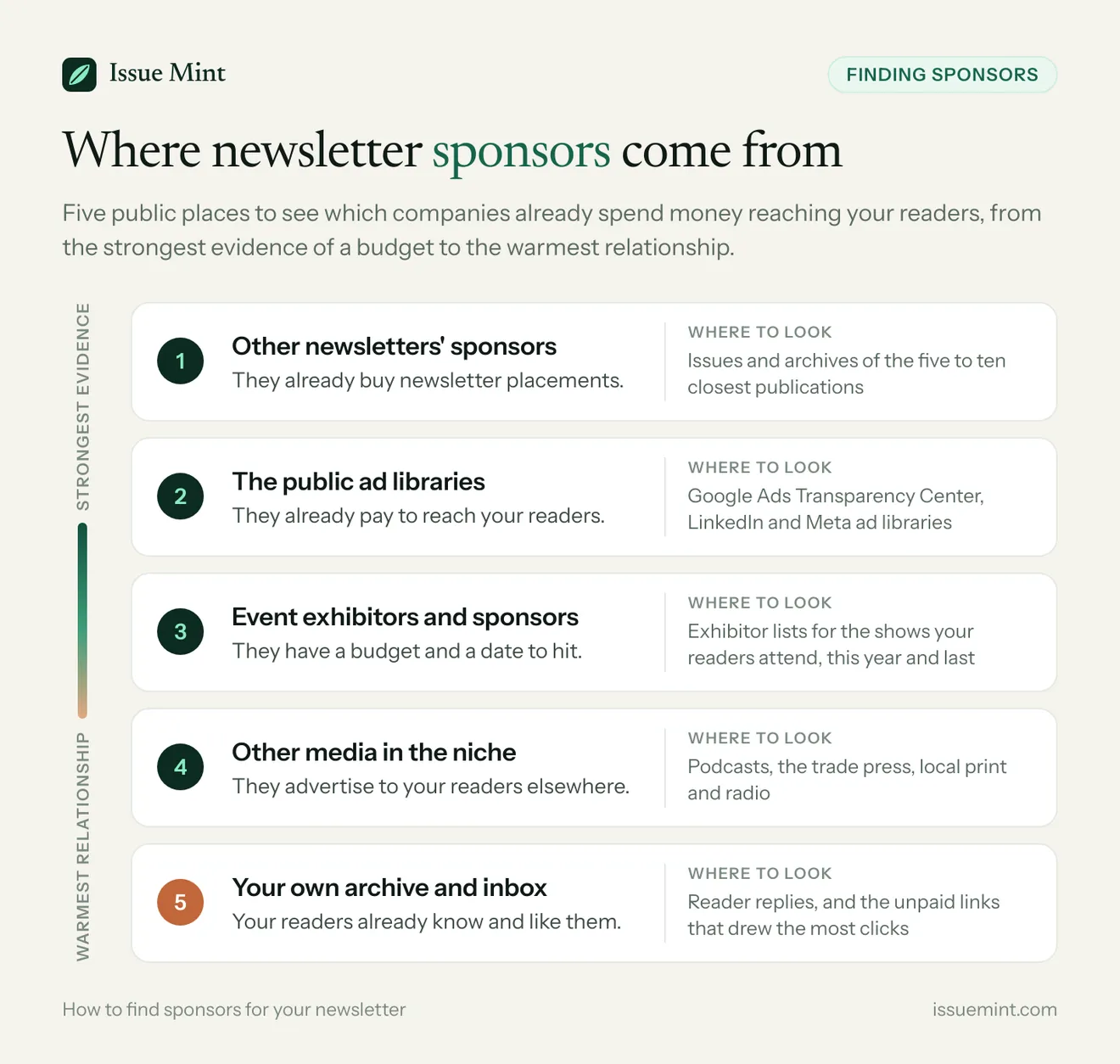
Five places to see who is already spending.
Every source below is public, and most cost nothing. They run from the strongest evidence of a budget to the weakest.
Other newsletters in your niche. Subscribe to the five to ten publications closest to yours, note every sponsor, and read back through their archives. A company that sponsors newsletters already has a budget line for what you sell. Dan Ni, who runs TLDR, put this first in his guide to finding newsletter sponsors on Indie Hackers, down to logging every new sponsor in a spreadsheet. Paid databases such as Who Sponsors Stuff track the same thing across hundreds of newsletters, though in a narrow niche your own reading usually covers it.
The public ad libraries. Google's Ads Transparency Center lets you look up the ads an advertiser has run and filter them by date and location. LinkedIn's Ad Library does the same for professional audiences, and Meta's for consumer and local ones. Search the libraries for the companies your readers buy from, then search Google for what your readers would type and note who pays to appear above the results. A company paying for clicks from your readers already knows what a visitor is worth, which is the comparison your price rests on.
The events your readers attend. Trade shows, conferences and awards publish their exhibitors and sponsors, and last year's lists are usually still online. An exhibitor has a marketing budget and a date when it badly wants attention.
Other media in the niche. Podcast sponsors, trade magazine advertisers and, for a local newsletter, whoever pays for the parish magazine or the bus shelters. A town roundup like Naptown Scoop has its sponsors within walking distance.
Your own archive and inbox. Companies your readers mention in replies, or clicked in large numbers when you linked to them unpaid. This is the warmest relationship on the list and the weakest evidence of a budget, so handle it carefully: never imply earlier coverage was for sale, and leave a gap between featuring a company and pitching it.
Build a list of twenty, with a reason against each.
Twenty companies you can each explain in a line will produce more replies than two hundred names copied from a directory, because every email can open with the reason you chose that company.
Keep it in a spreadsheet with a row per company and columns for where you saw it spending, why your readers in particular, the person to contact, the dates you wrote and the outcome. The spending column is the one that matters. If you cannot fill it in, the company is a guess.
Here is the start of that sheet for Front of House, the weekly for independent restaurant owners used in the newsletter sponsorship rate card template, which goes to 3,140 subscribers. The companies are described rather than named, and every detail is illustrative.
Company | Where you saw it spending | Why these readers |
|---|---|---|
Table booking platform | Sponsored two other hospitality newsletters this spring | Sells to exactly the owners who read the issue |
Till and payments supplier | Exhibited at the trade show most readers attend | Owners compare suppliers in the weeks after the show |
Linen hire firm | Search ads for "restaurant linen hire" in three cities | Already pays for visits from this audience |
Payroll service for small employers | LinkedIn ads aimed at hospitality managers | Targets the same job titles as the readership |
Speciality coffee roaster | Mentioned by four readers in replies last quarter | Readers already trust it |
To find the person, look for the job titles that hold the budget. At a company with a marketing team, Dan Ni's guide suggests searching its LinkedIn page for "demand generation" first, then "growth", then "marketing". At a small business it is the owner. A generic info@ address is where cold email goes to be ignored.
A newsletter sponsorship pitch email you can copy.
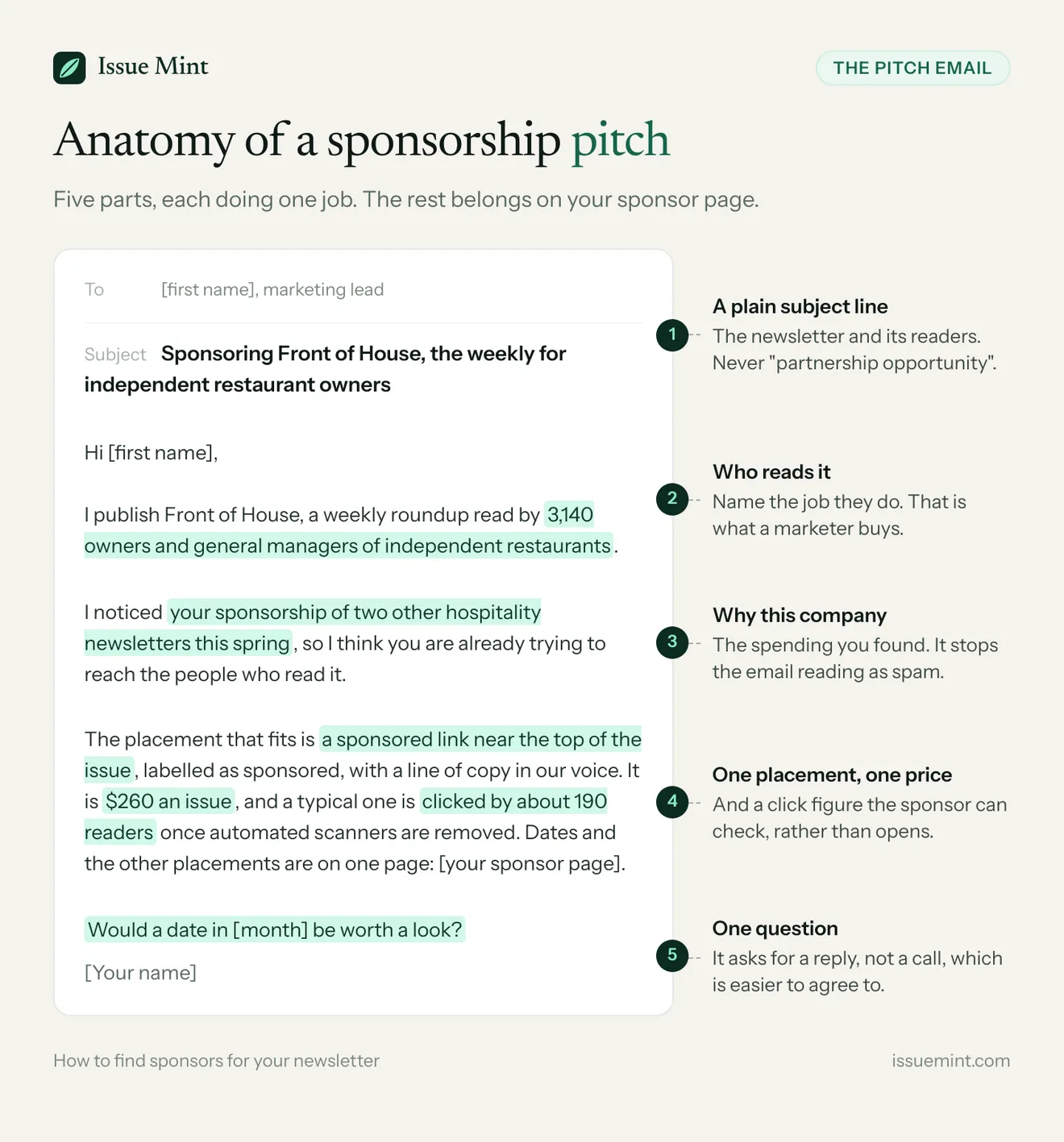
A pitch that gets answered is short, specific about who reads the newsletter, says why you chose this company, names one placement at one price and ends with one question. Everything else belongs on the sponsor page you link to.
Subject: Sponsoring Front of House, the weekly for independent restaurant owners
Hi [first name],
I publish Front of House, a weekly roundup read by 3,140 owners and general managers of independent restaurants. I noticed [your sponsorship of another newsletter / your stand at the spring trade show / your search ads for restaurant linen hire], so I think you are already trying to reach the people who read it.
The placement that fits is a sponsored link near the top of the issue, labelled as sponsored, with a line of copy written in our voice. It is $260 an issue, and a typical one is clicked by about 190 readers once automated scanners are removed. Dates, the other placements and what we ask of sponsors are on one page: [link to your sponsor page].
Would a date in [month] be worth a look?
[Your name]
Each sentence has a job. The audience line names what your readers do, because that is what a marketer buys. The evidence line is what stops the email reading as spam, and where most pitches fail by being generic. The delivery figure is clicks rather than opens, because a sponsor can check clicks against their own visitor numbers, and opens have been unreliable since Apple began loading images on readers' behalf. The closing question asks for a reply rather than a call, which is a much smaller thing to agree to.
Leave out attachments, which look like spam from a stranger, and the phrase "partnership opportunity", which every marketer has learned to skim past.
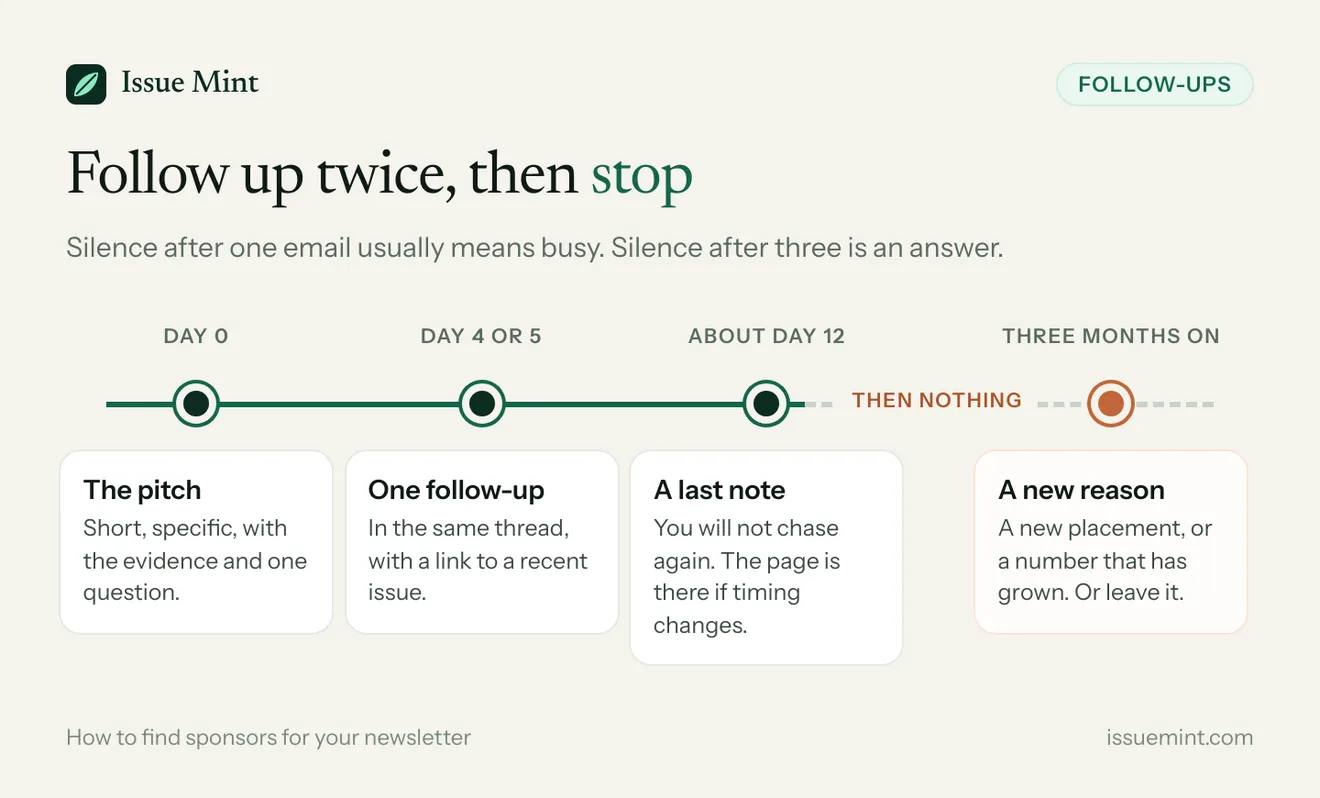
Follow up twice, then stop.
Most pitches get no reply the first time, and silence usually means busy rather than no. Send one follow-up four or five days later, as a reply in the same thread, with a link to a recent issue so they can see the placement in place. A week after that, send a short last note saying you will not chase again and that the page is there if the timing changes.
Then stop, and put a date in the sheet three months on. A company that said "not this quarter" has told you when to come back, and one that never answered may have a new marketing manager by spring. A second approach with a new reason is fair. A fourth email into the same silence is not, and in a small trade you will meet these people at the next show, where restraint now keeps you welcome.
Make the first sponsor an easy yes.
Your first booking is worth more as evidence than as income, so make it a low-risk decision. Offer a run of four issues at the run discount on your rate card, rather than a year. Send the click report within two days of each send. When the run ends, ask whether they would book again, because the answer is the most useful sentence you will get all year.
A sponsor in the issue also helps find the next one. A labelled sponsored item tells every other company reading that the slot exists and that somebody has paid for it, which is the evidence you went looking for in other newsletters.
Label it plainly, every time. The UK advertising code says marketing communications must be obviously identifiable as such, and the FTC's native advertising guide lists terms such as "Ad" and "Advertisement" as likely to be understood, while warning against vague ones like "Promoted". Issue Mint puts the word Sponsored above every sponsored item, in the email, on the website and in the plain text version, and it cannot be changed. Readers forgive a sponsor. They do not forgive being misled about one.
When a marketplace or ad network is the better route.
Selling direct is not the only option, and for some publishers it is the wrong one. A marketplace lists your newsletter for advertisers to find and book. An ad network supplies the advertiser as well, and pays by the click or the open. Both trade control and margin for not having to sell.
Route | Who finds the sponsor | Who sets the price | What you give up |
|---|---|---|---|
Selling direct | You | You | Your time, every week |
A marketplace | Advertisers browsing listings | You | A share of each booking |
An ad network | The network | The network, or an auction | Control of the price, and of who is on offer |
Terms differ by platform and change often, so read them before signing up. When checked in November 2026, Paved said its marketplace lets you set your own rates and takes a revenue share on bookings, while its ad network prices clicks by auction and pays monthly on net 60 terms. beehiiv's ad network is open only to publishers on its paid plans, and pays per click or per thousand opens depending on the campaign.
A network suits a publisher who wants none of the admin and has the volume to make per-click income add up. But its rates are set for its inventory as a whole, by auction or by campaign, and nobody makes the case for your particular readers the way a direct pitch does. Selling direct is how a niche gets paid for being a niche, and the two can run side by side: direct sponsors for the slots you sell, a network for issues that would otherwise go out without one.
What outreach will not fix.
Outreach finds sponsors for a newsletter that already has something to sell. If you cannot describe your readers in a sentence a marketer would recognise, no email will land, and that sentence is the work to do first. Most emails will get no reply at all, which is why the list has twenty rows rather than five.
It is also premature on a small list. Below roughly a thousand active subscribers, sponsorship rarely pays enough to justify a weekly sales habit, and the hours are better spent on the issues, as how to start a curated newsletter argues. Approach one company your readers already talk about, sell one slot, and write down what you agreed. And no outreach makes a bad fit right: a sponsor your readers would distrust costs more in goodwill than it pays.
Where the enquiries land.
Every route above ends with a sponsor asking which dates are free and what they cost, and the less of that happens in an email thread, the more outreach turns into bookings. On Issue Mint, the sponsor page and booking calendar list your slot types with their prices, and in calendar mode a sponsor ticks the dates they want and sends one enquiry. Those dates are held for seven days while you reply, the enquiry reaches your inbox straight away, and a confirmed booking waits in the composer for the right issue. You invoice the sponsor yourself, and Issue Mint takes no cut.
Start the sheet this week: five newsletters to read, a few searches in the ad libraries, one exhibitor list, and twenty rows by Friday.
Questions
How many subscribers do you need to get a newsletter sponsor?
There is no fixed threshold, because a sponsor is buying who reads a newsletter more than how many. A specialist list of a few hundred can sell an occasional slot to a company its readers already use. Pitching sponsors as a weekly habit starts to pay for itself at around a thousand active subscribers.
Should I use a newsletter sponsorship marketplace or sell direct?
Use a marketplace or an ad network if you want none of the selling and are happy for the platform to take a share or set the rate. Sell direct if your readership is specialist, because a direct pitch is where you can charge for that. Many publishers do both: direct sponsors for the slots they sell, and a network for issues that would otherwise go out without one.
What should a newsletter sponsorship pitch email include?
Who reads the newsletter, described by their job or interest rather than a subscriber count; the evidence that made you choose this company; one placement with its price and the clicks it typically gets; a link to your sponsor page; and one question. Leave out attachments and open rates.
How do I find the right person to contact about a sponsorship?
At a company with a marketing team, search its LinkedIn page for people with demand generation, growth or marketing in their job title. At a small business, write to the owner. Avoid generic addresses such as info@, which rarely reach anybody who controls a budget.
How should a sponsored link be labelled in a newsletter?
Plainly, right beside the item, in a word every reader understands. The UK advertising code requires marketing to be obviously identifiable, and the FTC's guidance in the US lists terms such as Ad and Advertisement as likely to be understood while warning against vague ones like Promoted. Issue Mint labels every sponsored item Sponsored, and the label cannot be changed.