
A newsletter sponsorship rate card template you can copy
What belongs on a newsletter sponsorship rate card, what to leave off, and a template you can copy, filled in for a weekly roundup with a few thousand readers.
Somebody has replied to last week's issue asking whether you have a rate card, and you do not. What you have is a price you once said out loud, a rough sense of where a sponsored link would sit, and an evening ahead of you laying out a PDF. Most rate cards are made in that evening, which is why most of them answer questions no sponsor asked and leave out the two that every sponsor does.
A newsletter sponsorship rate card is a short document: who reads the newsletter, what a sponsor can buy, what each placement costs and how to book one. Everything else is optional, and most of what gets added is padding. What follows is what goes on the card and why, a template to copy, the template filled in for an example publication, and the case for keeping the card as a page rather than a file.
What a rate card is for.
A rate card exists to turn "we might be interested" into a booking without a fortnight of email. Every sponsorship enquiry opens with the same two questions, what is available and what does it cost, and a card that answers both up front saves you writing the same reply forty times and saves the sponsor waiting for it. The third question, who actually reads this, decides whether they book at all, so it goes at the top.
That is a narrower job than a media kit in the magazine sense. A media kit is a pitch: pages of reader demographics, brand values and a founder's story. A rate card is a price list with just enough context to make the prices make sense. For a link roundup with a few thousand readers, the rate card is the media kit, and dressing it up as something bigger reads as exactly what it is.
Writing the card also does a quieter job for you. It forces you to decide what you sell and what you charge before anybody is waiting on the answer, which is the difference between quoting a considered figure and quoting the first number that sounds reasonable. If you have not settled the figure yet, the method in how to price a newsletter sponsorship comes first. The card is where the answer gets written down.
What goes on a newsletter sponsorship rate card.
Six things, in this order. The order matters because a sponsor reads from the top and stops when they have what they came for.
Who reads it, in two or three sentences. Not "professionals", and not "a highly engaged audience". Name the job, the interest or the place: independent restaurant owners in the UK, people who run community theatres, architects who specify timber. Say what the newsletter does for those readers and how often it arrives. This is the part of the card that does the selling, because a sponsor is not buying a slot in an email. They are buying a few minutes with a specific set of people they cannot easily reach anywhere else.
The numbers you can stand behind. Subscriber count is the figure everybody expects, and you can give it or withhold it as you prefer. Worth more to a sponsor is the figure that describes what a placement actually delivers: how many readers click a sponsored link in a typical issue. If your platform counts clicks per link with the automated scanners taken out, that line is the strongest one on the card, because a sponsor can turn it into a cost per visit and compare it with what they pay elsewhere. Leave open rates off entirely. The section on what to leave off says why.
The placements, each described plainly. These are your slot types: a sponsored link, a banner, perhaps a classified line at the foot of the issue. Two or three is plenty. For each one, say where it sits in the issue, what the sponsor supplies (a headline and a link, or an image and a link) and what the reader sees. Describe it as the sponsor will experience it rather than as you will build it. "A link near the top of the issue, marked as sponsored, with a line of copy written in the newsletter's own voice" tells them exactly what they are getting.
The price of each placement, per issue. One figure per placement, stated plainly. If some dates cost more, show the standard price as a "from" figure and say which dates are priced higher and why. Never write "contact us for pricing". The sponsors who will pay your price are put off by that far more than the ones who will not.
The run discount. A sponsor who books four consecutive issues has removed three slots of selling work from your year, and repetition is what makes a sponsorship perform, so they get a better result too. Give a modest discount for a committed run, paid up front. Ten to fifteen per cent makes a run worth booking without teaching the market that your published price is fiction. Put it on the card so it never has to be negotiated.
How to book, and what happens next. Where the upcoming dates are, how far ahead you need the copy or artwork, whether you write or approve the copy, and when the invoice falls due. Then one way to get in touch: a form, a calendar of dates or a single email address. Not all three.
That is the whole card. Anything added beyond this should earn its place by answering a question a sponsor has actually asked you.
The template.
Work down the table, write a line for each row and delete any row you cannot fill in without guessing. The sponsor will hold you to whatever the card says, so a blank beats a guess.
Section | What to write | Example |
|---|---|---|
Name and rhythm | One line: what the newsletter is and when it goes out. | A weekly roundup for independent restaurant owners, sent every Tuesday morning. |
Who reads it | Two or three sentences on the job, interest or place the readers share, and what they come for. Add the subscriber count here if you want to give it. | Owners and general managers of independent restaurants, most running one to three sites. They read it for supplier news, regulation and what other operators are trying. |
What a placement delivers | The one line you can defend, with how it was measured. | A sponsored link is clicked by around [n] readers in a typical issue, counted after automated scanners are removed. |
Placements | One row per slot type: where it sits, what the sponsor supplies, what the reader sees, the price per issue. | Sponsored link, near the top of the issue, marked as sponsored, one line of copy in our voice: $[price] per issue. |
Runs | The discount for consecutive issues and how it is paid. | Book four consecutive issues and the price is [x] per cent lower, invoiced in full at booking. |
Dates and lead time | Where the dates are listed and when you need the material. | Upcoming dates are on the sponsor page. Copy or artwork by the Thursday before your issue. |
What we ask of sponsors | What you refuse to run, and who writes the copy. | We do not run gambling, betting or anything we would not recommend unpaid. We write the line under your link and send it to you before the issue goes out. |
Payment and reporting | When the invoice is due and what the sponsor gets afterwards. | Invoiced on confirmation, due within 14 days. A click report for your placement within 48 hours of the send. |
To book | One route only. | The sponsor page, or one named email address. |
Filled in for one newsletter.
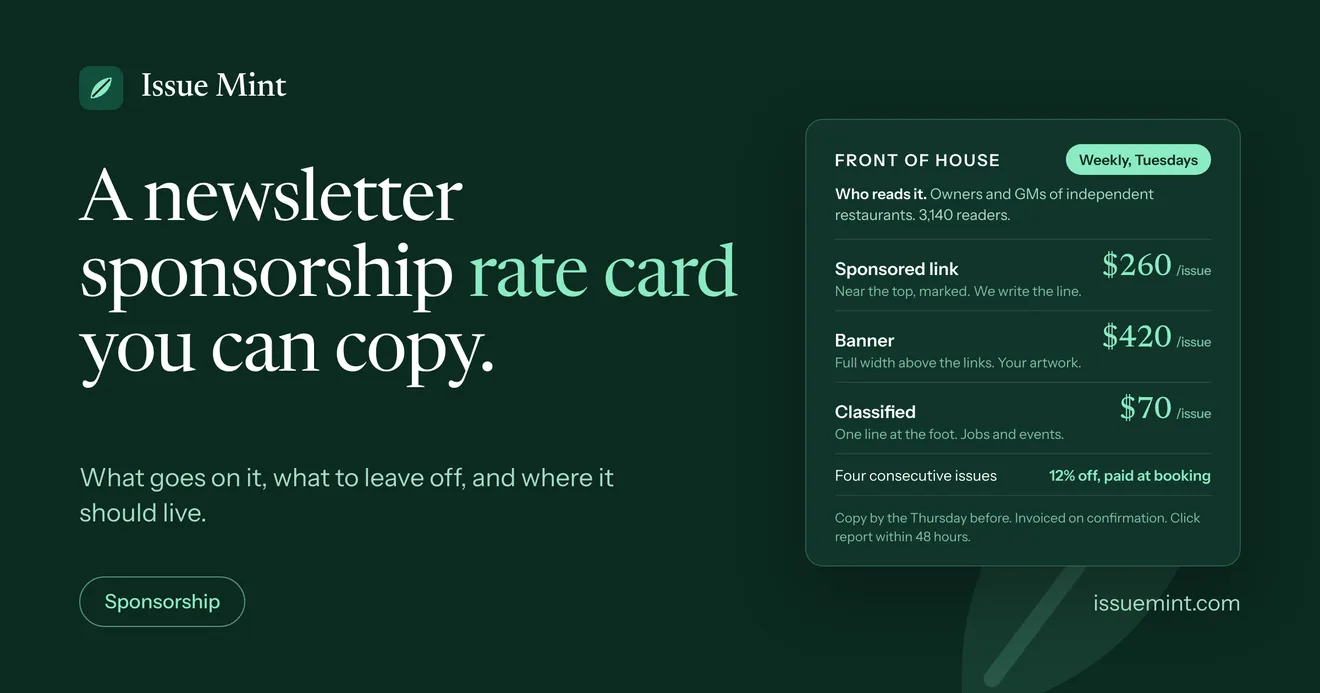
Suppose the newsletter is Front of House, a weekly for independent restaurant owners that goes out on Tuesday mornings to 3,140 subscribers, and a sponsored link in a typical issue is clicked by about 190 readers once the scanners are taken out. Every figure here is illustrative. The shape is the part to copy; the numbers have to be yours.
The audience section says who the readers are and what they run, in three sentences, and gives the count because in this niche the count is respectable. The delivery line gives the 190 and says how it was measured. Then the placements:
Placement | Where it sits and what the sponsor supplies | Price per issue |
|---|---|---|
Sponsored link | Near the top of the issue, marked as sponsored. You supply a headline and a link; we write the line underneath. | $260 |
Banner | A full-width image above the links. You supply the artwork and a link. | $420 |
Classified | One line at the foot of the issue, for jobs, events and small offers. You supply the line. | $70 |
Underneath the table: four consecutive issues at 12 per cent off, invoiced at booking. Copy by the Thursday before. No gambling, no betting, nothing the editor would not recommend unpaid. Invoice due within 14 days. Click report within 48 hours. The sponsor page carries the dates, and the page is the way to book.
Check the sponsored link against the pricing method. At $260 for about 190 qualified visits the sponsor is paying under $1.40 a visit, which is the comparison they will make against what a visit costs them through paid search in the same trade. The price also implies a cost per thousand recipients of about $83, which is defensible for a specialist trade audience and easy to explain if anybody asks.
That is the whole thing: about three hundred words, one table and a way to book. It fits on a single page, and a sponsor can read it in the time it takes to decide.
What to leave off.
Open rates are the first thing to cut. Since Apple began loading images on readers' behalf, an open no longer means a person looked, so the figure flatters every newsletter. A sponsor who knows that discounts it, and a sponsor who does not will be disappointed later. Clicks are the number to sell on, and tracked links with the scanners removed are what make that number honest.
Then, in no particular order:
Social follower counts. Different people paying a different kind of attention, and a sponsor buying a newsletter placement is not buying them.
A placement for every occasion. Eight slot types means a sponsor choosing between things they do not understand, and the choice they usually make is not to.
Testimonials you do not have yet. A blank is better than an invented one, and the first sponsor who books twice will give you a line worth adding.
Your own story. One sentence on who you are is plenty. The readers are the product.
Adjectives about the audience. "Highly engaged" and "premium" describe nothing. The job title does the work.
Where the rate card lives.
A rate card belongs on a page at a predictable address on your newsletter's website, linked from the footer of every issue, not in a PDF attached to an email. A file is out of date the day you change a price and can never say which dates are still free. A page can do both, and a sponsor who found your archive through a search engine can find the rate card without writing to ask. When somebody insists on a PDF, send the link first and print the page if they still want it.
On Issue Mint every newsletter has a sponsor page at /sponsor from the day it is set up. The placements section is built from your slot types, each with the description you wrote and its price shown as a "from" figure, so the copy from the template above goes straight into the slot descriptions. The subscriber count is a toggle, off by default. In enquiry mode the page ends with a form. In calendar mode it also lists upcoming issue dates with what is free, what is on hold and what has sold, and a sponsor ticks the dates they want and sends one enquiry covering all of them. If you would rather keep the card on your own site, write it there and point the sponsor at the Issue Mint page to send the enquiry, which is what puts their dates on hold and gets the email to you. How the sponsor page and the calendar work is covered in the documentation.
How the card changes as the newsletter grows.
A first rate card has two placements, no subscriber count and an enquiry form, and that is the right card for a newsletter that has not sold a slot yet. Publish a price you would be pleased to get and let the first few enquiries tell you whether it is right. Slots that keep selling out are the signal to raise it.
Once bookings arrive with any regularity, the card grows in three places. Dates get published rather than quoted, because a calendar showing what has gone is itself a piece of sales copy. Individual dates get priced above the standard when an issue is worth more: the year-in-review issue, the one before the trade show every reader attends, the last issue before a budget year ends. And the run discount gets a companion, category exclusivity, where a sponsor pays a premium for a promise that a competitor will not appear in the same issue. Only offer that once you have competing sponsors to keep apart, because promising exclusivity to your only sponsor is giving away something for nothing.
What should not change is the length. A card that started as a page and became a deck has usually gained the padding it was right to leave out.
What a rate card does not do.
A rate card does not find sponsors. It converts the interest of people who already know the newsletter exists, which is why the readers-first advice in how to start a curated newsletter holds here too: the sponsor who books first is usually a reader, or somebody a reader forwarded an issue to, and no card reaches them before the newsletter does.
Below a few hundred subscribers, the card is premature. Sell the first slot by email, to a company your readers already talk about, at a price that feels slightly high. Then write down what you agreed. That is your first rate card, and it will be more accurate than anything drafted in advance.
There is a different route, which is to hand the selling to a marketplace or to a platform's advertising network. There the platform sets or steers the rate, finds the buyers and keeps a share, and for a publisher who wants no part of the admin that is a reasonable trade. It is not the trade this post is about. A rate card is the tool for the publisher who would rather choose their own sponsors, set their own price and invoice on their own terms, and selling sponsorships from your own sponsor page is what Issue Mint builds for that publisher: slot types, a calendar of dates, an enquiry inbox with confirm and decline, and no cut of what you charge.
Questions
Do I need a media kit as well as a rate card?
Not for a newsletter with a few thousand readers. A media kit is the fuller pitch a magazine sends to agencies. For a curated newsletter, a rate card with two or three sentences on who reads it and one honest delivery figure is the media kit, and a longer document mostly adds padding a sponsor will skip.
Should I publish my sponsorship prices?
Yes. A published price answers the first question in every enquiry, filters out sponsors who were never going to pay it and stops you quoting a different figure to each person who asks. Show the standard price as a "from" figure if some dates cost more, and never write "contact us for pricing".
Should I put my subscriber count on the rate card?
Only if it helps your case. A specialist list of a few thousand can be worth more to the right sponsor than a general list ten times the size, so lead with who the readers are and add the count when it supports that. A sponsor who cares about the number will ask, and you should answer plainly when they do.
How often should I update a rate card?
Whenever a price changes or a slot sells out, which is the main argument for keeping the card as a page rather than a PDF. Review it every quarter regardless: check the delivery figure against your recent click reports, raise the price if the last few slots sold without a conversation, and remove any placement nobody has booked.
What should I do when a sponsor asks for a discount?
Offer the run discount already on the card, for a commitment paid up front, rather than a lower price for a single issue. If they want one issue at a lower price, the answer is that the price is the price. A sponsor who leaves over that was unlikely to book twice.